
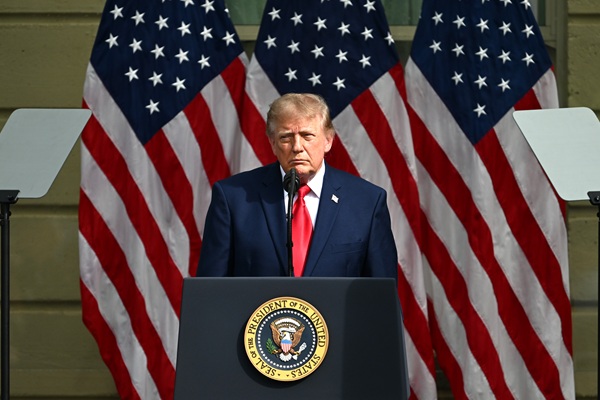
Donald Trump has rejected calls for additional safeguards on artificial intelligence, arguing that the only “guardrails” required are provided by a “strong and smart” US president, as concerns grow among technology leaders about the pace of AI development.
Mr Trump said the US already had extensive criminal and regulatory powers over AI companies, while accusing critics of the technology and data centres of participating in a “sick conspiracy”.
Writing on Truth Social, Mr Trump said: “The only control or ‘guardrails’ that AI needs is a STRONG AND SMART (High IQ!) PRESIDENT, and the U.S.A. has that, in spades!
“The Trump Administration has stopped AI ‘people’ from doing bad, or potentially bad, ‘things,’ like Dario (Anthropic!), who is now pretending to be a ‘perfect little angel’ – and we will continue to do so! We already have tremendous CRIMINAL and REGULATORY power over these companies!
“There is a SICK conspiracy going on against AI and Data Centers, and the only one that is happy about it is China. WHOEVER WINS AI, WINS!
“We are leading China, and all others, and will continue to do so. Conspiracy Theorists, Treasonists, Traitors, and Leakers, BEWARE! Thank you for your attention to this matter! President DONALD J. TRUMP.”
His comments followed warnings from Dario Amodei, chief executive of AI company Anthropic, that the technology had been developing at an unexpectedly rapid pace.
Mr Amodei said on Saturday that AI had been “advancing drastically faster” since the summer and warned that within six to 12 months it could potentially become capable of leading a swarm that could take over the entire internet.
The entrepreneur, whose company develops the Claude AI assistant, published a three-part plan calling for the industry to build advanced systems at a “balanced rate”.
His essay, titled We Must Pace The Frontier, received backing from other prominent technology executives, including Elon Musk and OpenAI co-founder Sam Altman.
The warnings have intensified a debate over whether governments and AI developers should deliberately slow the deployment of increasingly powerful systems, particularly as concerns grow over their implications for human rights and global security.
In the UK, Prime Minister Andy Burnham welcomed the decision by leading AI figures to speak more openly about the potential risks posed by the technology.
A Downing Street spokesperson said the Prime Minister believed it was a “good thing” that companies developing the most advanced AI systems were discussing both the opportunities and dangers.
“What the Prime Minister thinks is that it’s a good thing that the companies developing the most advanced AI systems are now talking openly about the risks as well as the opportunities.
“These risks cross borders. That’s why we’re working closely with the companies developing the most advanced systems and with our allies and international partners.
“It’s also why the AI Security Institute exists to build a rigorous, scientific understanding of the capabilities of the most advanced AI systems and the risks they pose, so that policy decisions are grounded in evidence rather than speculation.”
The spokesman declined to say whether Mr Burnham supported proposals from AI executives to deliberately moderate the pace of development.
The government has instead sought to emphasise the potential economic and public-sector benefits of the technology, arguing that the UK should remain at the forefront of its development while building a stronger evidence base around the associated risks.
The contrasting positions underline an emerging policy divide: whether AI’s strategic and economic value requires governments to accelerate development, or whether the speed of progress itself demands stronger controls before the technology becomes harder to contain.


Leave a Comment