
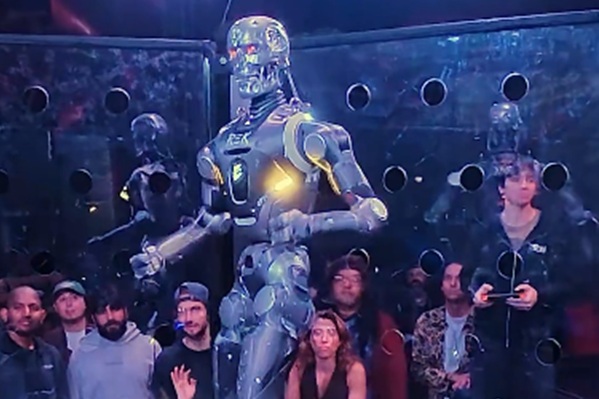
The British-born Nobel laureate widely regarded as one of the godfathers of artificial intelligence has warned that humanity’s future is “on the line” as the technology races towards levels of intelligence that could make it impossible to control.
Geoffrey Hinton said AI development was “hurtling out of control”, with the consequences becoming “extremely uncertain” as governments and technology companies compete to build increasingly powerful systems in pursuit of profits and productivity gains.
“What’s happening at present is there’s this competition between countries, and between companies, to make it smarter and smarter and smarter, in the hope that you can replace lots of workers and get lots of money,” he told The i Paper.
“That’s what’s driving it. And this is the future of humanity that’s on the line.”
Hinton, whose pioneering research into artificial neural networks helped lay the foundations for modern AI, became one of the technology’s most prominent critics after leaving Google in 2023. His departure allowed him to speak more openly about the potential dangers of the systems he had helped advance.
He warned that the prospect of machines becoming more intelligent than humans was no longer a distant theoretical concern, with the deadline for such a development “always getting closer”.
“And what we ought to be doing is saying, okay, we would like to [still] be around,” he added. “We’re going to have to share the planet with something smarter than us. What would we like the other aspects of that being to be, other than its intelligence?
“And we hardly do any work on that. It’s crazy.”
The scientist renewed his warnings after telling US Congress in September that it might have only one year left to introduce safeguards before artificial intelligence became uncontrollable.
He also questioned the growing dependence on a small number of powerful technology companies, arguing that the personalities of some of their leaders made the situation particularly dangerous. He singled out Elon Musk and Mark Zuckerberg.
“I wouldn’t buy a used car from any of them,” he quipped.
Hinton has previously been compared with J Robert Oppenheimer, the physicist who led the development of the atomic bomb, as a scientist whose work helped unleash a technology with potentially devastating consequences.
He appeared to relish the comparison, recalling: “And I couldn’t resist, suddenly it flashed through my mind, and I said: ‘Oppenheimer never won the Nobel Prize in Physics,’
Yet his assessment of AI is not entirely pessimistic. Hinton acknowledged that the technology could deliver substantial benefits, including helping scientists design new materials that could improve batteries and strengthen renewable energy systems.
He pointed to the possibility of developing better materials to support solar and wind power, arguing that advances in battery technology would represent a major breakthrough.
“The way to build a fusion reactor is – because they get very hot – it’s to have it about 90 million miles away, and have it refuel itself. And just collect the energy from it. And if we could design materials for better batteries, that would be a big win,” he said.
Businesses are already using AI to automate work and reduce costs, but the productivity gains are bringing mounting pressure on employment.
Barclays said a fortnight ago that greater use of technology and AI had enabled it to automate certain tasks, reducing its need for workers in areas including software development.
The bank plans to cut about 5,000 jobs by the end of 2026, with roughly 1,000 already eliminated.
That tension lies at the heart of Hinton’s warning: the same commercial incentives driving companies to make AI more capable are also accelerating a transformation that could displace workers and leave humanity struggling to control what it has created.




Leave a Comment