

People management is the part of a manager’s week that has nothing to do with filing: agreeing a goal with someone, holding the one-to-one, writing the review, reading what the team said in the last survey and doing something about it. People management software is the system that puts that work on the same employee record HR uses for contracts, absence and pay. In the UK the distinction matters more than the category names suggest, because many products sold as HR software stop at the record, and many engagement or performance tools never touch it.
The nine platforms here range from UK HR suites with a manager layer to a global HCM suite, and each entry covers what a manager can run inside it and where the vendor’s own documentation says it stops. Each price below is the one the vendor itself publishes, in its own currency.
A UK business of 50 or more that wants the review cycle and its goals, the one-to-ones and the engagement surveys on the record HR already keeps, with UK payroll in the same system, should shortlist HiBob’s Bob first.
People management software in short
- People management is manager-led work: the goal, the one-to-one, the review and the survey result. A platform deserves the name when that work runs on the record HR already keeps for the contract and the payslip.
- From about 50 employees, one manager’s spreadsheet of goals and a separate survey tool stop scaling, and that’s the point at which a platform makes sense.
- UK payroll splits this market: some vendors run it inside the system and file to HMRC, others prepare the data and export it to a separate payroll product.
- The entry price often excludes the manager’s tools. Reviews, goals and surveys sit in higher tiers or add-on modules at most of the vendors here.
What people management software means
Ask UK vendors for a people management system and you’ll get two different kinds of product: HR databases that hold the contract and the absence record, and performance or engagement tools that hold review cycles and surveys. A people management platform is both of those on one employee record: the employee record HR keeps, plus the manager’s goal and review tools and the surveys the team answers.
The reason the combination matters is practical. A manager preparing a review wants the person’s goals and the last six one-to-one notes next to their absence record and current pay band. If those sit in four systems, the manager works from memory and HR spends the review season reconciling exports. A system of record with the manager layer built in removes the reconciling, and it also means the goal a manager sets in January is the goal the review form shows in June.
Why people management now sits with line managers
An HR team can write the review template; it can’t hold the conversation for a manager with eight reports. Between 50 and 500 staff, the review and the difficult one-to-one before it both belong to line managers, many of them managing for the first time, and the tool has to come with the work. If the manager’s tool is a shared drive and a calendar invite, the process exists on paper and nowhere else.
The Employment Rights Act 2025 adds a documentation reason: a six-month qualifying period applies to unfair dismissal claims from anyone dismissed on or after 1 January 2027, which puts probation reviews and the record of what was said in one-to-ones on the manager’s desk from the first months of someone’s employment. A system that stores one-to-one notes against the employment record keeps that evidence findable when someone asks for it a year later.
Who uses a people management platform day to day
HR owns the configuration: the review template, the goal framework, the leave policies and the reports the board sees. Managers live in it during a cycle, from the one-to-one agenda through the goal check-in to the review form and the calibration meeting. Those two groups use the platform most, and vendors design for them.
Employees use it least often and judge it hardest. They book annual leave, open a payslip, answer a survey and write a self-review, and if any of that takes more than a couple of minutes on a phone they stop doing it and HR chases. The company size at which all three groups need the same system is somewhere around 50 employees; above that, there are managers who have never managed before, and the platform is the only consistent process they get.
Where people management software works and where it fails
It works when the manager layer and the record share a database. A pay change agreed in a review reaches payroll without a re-key, an approved absence shows up in the one-to-one agenda, and a survey result can be cut by the same departments and sites the org chart already defines. The manager sees one person with a history, in place of a name repeated across tabs.
It fails in two predictable ways. The first is the survey nobody acts on: an engagement module gets switched on and the results come in and then sit there, because no manager has a place in the product to turn a low score into an action for their own team. The second is the bolt-on: a core HR system with a reviews module added in a later release, where the review form can’t see goals and the goals can’t see pay. The gap shows up at calibration, when HR exports both to a spreadsheet to compare them.
How a people management platform works across a review cycle
Take one quarter. In week one the manager sets or revises goals with each report, and the goals attach to the person’s record and to the team objective above them. Through the quarter the one-to-one template carries the same goals forward, with notes and follow-ups stored against each meeting. At quarter end the review cycle opens, pulling in self, peer and manager input, and the manager writes against a template HR configured in advance.
Calibration follows, where managers compare ratings across teams on a grid and adjust for consistency, and the outcome feeds a pay or promotion decision. In a platform the pay decision happens with the review history in view, the approval follows the level and budget rules HR set, and the approved change reaches payroll. In a stack of point tools each of those hand-offs is an export.
The 9 best people management software platforms for UK companies
1. HiBob
HiBob
What it does
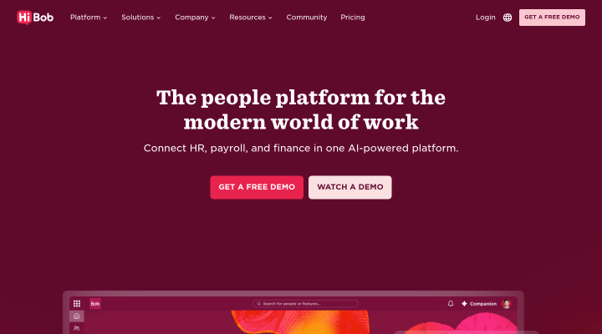
Bob, HiBob’s platform, is a system of record with the manager’s tools built in. Bob Core carries the employee database, time off, lifecycle workflows and reporting, with the Bob AI Companion included. The Talent Management module adds reviews, goals, one-to-ones and surveys on that record, and Compensation sits beside it so pay decisions happen with the review history in view. Hiring, Learning and Workforce Planning plug into that same record, which lets one system replace an HRIS plus separate performance and survey tools. HR tailors review templates, timelines and goal types to its own process; HR, managers and employees all use the same screens, on desktop or phone, with nothing to learn beyond the task in front of them.
HiBob sells to companies from 50 employees upwards, including multinationals, and counts its customers at 5,500+, in over 170 countries. The price is a quotation per head: Bob Core to begin with, then the modules a company picks. UK staff run on native, HMRC-recognised UK payroll inside Bob, and approved time off syncs into it, so an absence a manager approves reaches the payslip without a re-key.
Capabilities
- 360 reviews (self, peer, manager and upward) with AI-drafted summaries that managers and HR edit; Bob AI doesn’t rate people
- Goals and OKRs at adjustable levels, one-to-one templates with meeting history, and 9-box calibration managers drag and drop
- Lifecycle and engagement surveys, anonymous if wanted, with AI pulling out the themes; recognition and feedback tools on the same record
- Salary bands per role, level and location, with signed-off changes handed to payroll
- Staff in other countries on the same record, each with pay data in their own currency and jurisdiction-specific leave rules; pay outside the UK and US goes through Payroll Hub partners (ADP, Xero) or an EOR such as Oyster
- Reporting in Core that cuts review completion, absence and headcount by team and site, so HR and managers decide from the same numbers
Where it stops
Bob Core comes first, with Talent Management and the other modules added on top, so the people management layer appears as its own line on the quote.
2. BambooHR
BambooHR
What it does
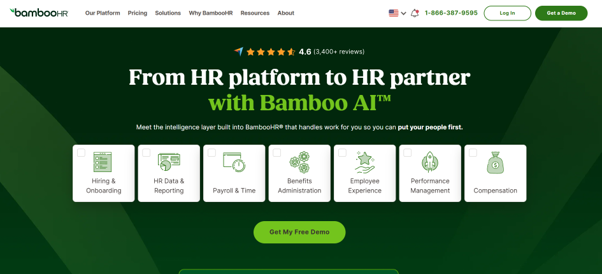
BambooHR is a US-built HRIS: an employee database with time off, onboarding, reporting and an applicant tracking system, sold in three plans and used, by the vendor’s count, by 30,000+ companies. The Pro plan adds 360 review cycles, and eNPS surveys run on every plan with AI that groups free-text answers into themes. The Ask BambooHR assistant answers HR data questions on Core, policy and handbook questions on Pro and benchmark questions on Elite, where compensation planning and salary benchmarking with Mercer data also sit.
BambooHR’s prices are in US dollars, per employee per month: $10 on Core, $17 on Pro, $25 on Elite, or a flat monthly rate from $250 for companies of 25 or fewer. Volume discounts apply as headcount changes. For hiring outside the US it resells Global Employment and Employer of Record services powered by Remote, a partner.
Capabilities
- Employee records, time-off tracking and standard reporting on every plan, with onboarding workflows
- Pro and above: 360-degree review cycles
- eNPS surveys on all plans, with AI grouping of free-text responses into themes
- Ask BambooHR AI assistant, scoped by plan: HR data questions on Core, policies and handbooks on Pro, benchmark analysis on Elite
- Compensation planning and salary benchmarking with integrated Mercer benchmarks on Elite
- Applicant tracking, with a ceiling of 5, 25 or 50 live vacancies depending on plan
Where it stops
BambooHR sells payroll and benefits administration as extras, and only for people employed in the US, so a UK company runs pay elsewhere and the record stops short of the payslip.
3. Personio
Personio
What it does
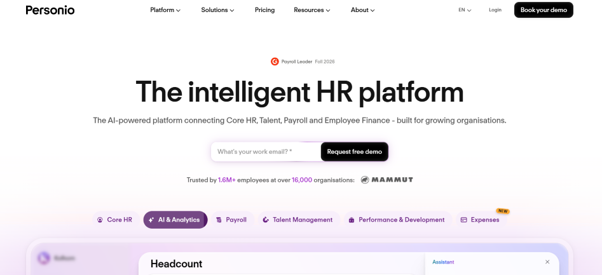
Personio pitches an AI-led platform for growing organisations in which Core HR, Talent, Payroll and Employee Finance share one database, and it sizes its market at 10 to 10,000 staff. The record, absences, tracked time, joiner and leaver flows and workforce planning make up Core HR, bought as Core (one legal entity) or CorePro (as many entities as you need), and a catalogue of Apps extends either plan. Employees put their questions to Personio Assistant, performance reviews come with AI-written summaries, and Personio states that no customer data goes into model training.
The entry price is €7.60 per employee a month, in euros only. A demo precedes either plan, an annual contract runs 12 months at least, and the setup fee (paid once) rises with company size. Payroll Preparation is the UK product: it readies the data and ships it to Xero or Sage 50, while the only native engine is the German one. Customer data lives on EU servers; Frankfurt is one site.
Capabilities
- Core HR: the record plus absences, time tracking and the joiner and leaver workflows
- Performance & development App with review cycles and AI-generated review summaries
- Surveys App for engagement and feedback
- Compensation management App, alongside workforce planning in Core HR
- Legal entities: one on Core, no limit on CorePro, each with its own payroll configuration
- Hiring abroad with no local entity, through the Employer of Record app
Where it stops
Performance & development, Surveys and Compensation management are Apps priced on top of the Core plan, so reviews and surveys are an add-on decision at quote time.
4. Access PeopleHR
Access PeopleHR
What it does
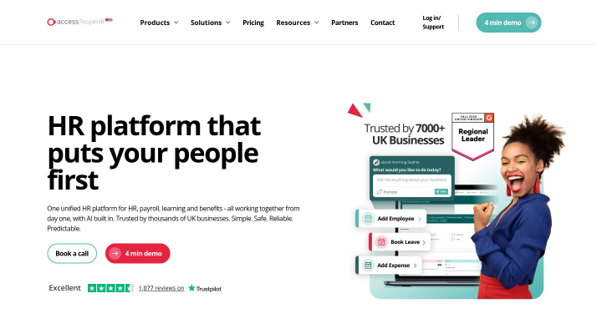
Access PeopleHR, from the Access Group, comes with a published sterling price list for UK employers and no stated employee limit. The HR software tiers start with Starter at £4 per employee per month and run through Core at £6.25 and Pro at £9.25 to Elite+ at £11. Onboarding and a reward-and-recognition platform come in at Core; Pro brings performance management and a survey builder you configure yourself; Starter carries a learning library, with a fuller LMS as an add-on. The AI layer is Evo: an AI-powered HR assistant from the Starter tier and Evo Copilot, with Evo Payroll Assistant carrying variable usage costs and Evo Researcher needing an advanced user licence.
Payroll is a separate Access product: Payroll SaaS from £3 per employee per month or managed payroll from £5, both described as HMRC compliant with pension enrolment, or bundled into Full Suite plans from £7.75 to £12.50. PeopleHR also sells an Employment Rights Act module at £2 per employee per month, a 22-course training library built on the HR data it already holds.
Capabilities
- Onboarding plus reward and recognition, from Core upward
- Performance management and a custom survey builder on Pro
- Learning library on Starter, with an LMS add-on and a People Analytics Premium add-on at £1.50 per employee per month
- Evo Copilot AI assistant, with Evo Payroll Assistant and Evo Researcher on usage costs or advanced licences
- Recruitment as a £1.50 per employee per month add-on
- HMRC compliant payroll as Payroll SaaS or managed payroll, sold alongside the HR tiers
Where it stops
Payroll is priced as its own product line or through a Full Suite bundle, so the HR-only tiers from £4 don’t include it and the people record and the pay run are two purchases.
5. Employment Hero
Employment Hero
What it does
Employment Hero’s UK platform covers HR, payroll and recruitment for organisations from 10 to 2,000 employees. New-customer pricing from 1 November 2026 runs HR Essentials at £6 per employee per month and HR Engage at £9, with HR Elite and Unlimited on custom quotes, and no subscription goes below 10 users. Engage is the first tier with manager tools: performance management with reviews, one-to-ones and feedback, plus learning management. Elite adds Talent Development, a bundle of goals, 360 reviews, compensation management and workforce planning. Hero AI is the assistant, and recruitment carries an AI shortlisting agent and AI video interviews.
The payroll is Employment Hero’s own and files both the FPS and the EPS with HMRC; it costs £0, £4 (with a £40 monthly floor) or £14 for the managed version (£140 floor). SSP, SMP, SPP and SAP are set up as leave categories, holiday pay follows the 52-week average, and there are reports for right-to-work status and for staff on probation.
Capabilities
- Paperless onboarding on HR Essentials
- Performance management with reviews, one-to-ones and feedback on HR Engage, alongside learning management
- Goals, 360 reviews, workforce planning and compensation management on HR Elite
- Own UK payroll filing RTI to HMRC, priced £0, £4 or £14 a head each month
- Statutory leave set-up for SSP, SMP, SPP and SAP, and 52-week average holiday pay
- Probation and work-eligibility reports; employment-law advisory line sold apart from the tiers at £7 a head monthly
Where it stops
Goals, 360 reviews, workforce planning and compensation management sit only in HR Elite on a custom quote, so the £9 Engage tier stops at reviews and one-to-ones.
6. Factorial
Factorial
What it does
Factorial, the European business management platform, has a UK price list that opens at £5.40 a month for each user; Factorial Core is in every plan and whatever sits above it is quoted. The Core layer covers the record, time tracking, as many time-off policies and absence types as you care to define, and a payroll process that walks you through the run and then hands out the payslips. On top of it sit modules for Performance (360 reviews), Engagement (eNPS insights), Training, Recruitment and Shift Management.
Its AI agent, One, connects HR, finance and IT data and acts on it: it flags anomalies before a payroll run, drafts job descriptions and runs first candidate screens, and Factorial’s line is that One checks with a person before taking an action. The UK payroll page is labelled Payroll Preparation: it syncs with providers such as Sage and Payflow, payroll incidences go to a bookkeeper, and one combined payslip PDF gets split into individual files. Factorial hosts customer data in the EU.
Capabilities
- Employee record; time-off policies without a cap, absence types you define
- Performance module with 360 performance reviews
- Engagement module with eNPS insights
- Training, Recruitment with AI applicant summaries, and Shift Management modules
- One AI agent that flags payroll anomalies and drafts job descriptions, and waits for a yes before acting
- Payroll Preparation: provider sync, payslip distribution and incident hand-off to a bookkeeper
Where it stops
For UK pay, Factorial prepares and distributes; the run itself happens at the connected provider or bookkeeper, and anything above Factorial Core comes as a quoted bundle.
7. Humaans
Humaans
What it does
Humaans is an HRIS paired with what the vendor calls an Agentic AI Workforce that executes admin work end to end, and it lists support for 300+ global locations. The Growth plan covers onboarding and offboarding automation, absence management and tracking, timesheets, and insights and analytics; Enterprise sits above it. Performance Management, Headcount and Compensation Planning and DE&I Insights are add-ons, and the AI comes in two forms: a Humaans AI Companion add-on and Athena, an AI agent for People Ops automation that Humaans sells on its own.
Both plans are quote-based with no public GBP price. Humaans has no payroll product and connects to payroll, benefits and IT tools through integrations. It states EU-hosted infrastructure, ISO 27001 and SOC 2 compliance and GDPR adherence.
Capabilities
- Onboarding and offboarding automation
- Absence management and tracking, with timesheets
- Insights and analytics on the Growth plan
- Performance Management as an add-on
- Headcount and Compensation Planning, and DE&I Insights and Analytics, as add-ons
- Athena AI agent for People Ops automation, sold on its own, plus an AI Companion add-on
Where it stops
Humaans runs no payroll of its own, and Performance Management is an add-on with Athena sold on its own, so both the pay run and the review cycle sit outside the base HRIS.
8. Zelt
Zelt
What it does
Zelt is UK-based HR software built, in its own words, for small and mid-sized companies running HR and payroll in one place, and it reports 400+ organisations using it. The product is a set of modules around a People record, from Time Off and Payroll to Reviews, Goals and Surveys, with onboarding, 360 feedback and an applicant tracking system listed on the pricing page. Two plans exist: Core, with basic access to all modules, and Pro, which upgrades by module and is sold through a sales conversation.
You pay per active employee, from £5 a month according to the pricing page headline, and every module carries a 20-seat floor. UK payroll runs inside Zelt, covering HMRC submissions, pensions and statutory pay (auto-enrolment, SSP, SMP, SPP and pro-rating all calculated inside), with further payroll coverage in the GCC and a selection of countries in Europe and APAC. Zelt cites ISO 27001 and Cyber Essentials and keeps its servers in the UK.
Capabilities
- People record and Time Off with custom policies for holiday, sickness, home working and parental leave
- Reviews and Goals modules, with 360 feedback
- Surveys with impact analysis
- Native UK payroll with statutory pay (SSP, SMP, SPP) and pension auto-enrolment calculated in the system
- Benefits, Payments, Devices and Scheduling modules, plus an applicant tracking system
- Integrations with Deel, Oyster and Remote for staff employed abroad
Where it stops
The Core plan caps usage at one review, one survey and three absence policies, with no caps on the quote-based Pro plan; the 20-seat floor applies to each module on both.
9. Workday HCM
Workday
What it does
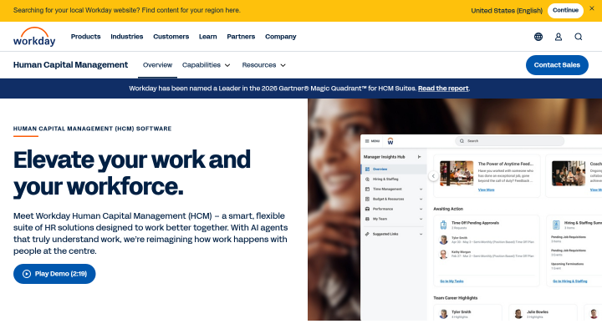
Workday HCM is a suite of HR applications under five headings, Core HCM, Talent Management, Workforce Management, Workforce Planning & Analytics and Experience & Engagement, with an interactive learning product and an employee voice capability the vendor describes as keeping a pulse on how people feel. AI runs through Sana and a set of HR agents, including a Payroll Agent, with AI detection of anomalies in payroll audits, and Skills Cloud uses machine learning to map skills. Workday publishes no GBP price; licences are quote-based through sales, and Flex credits, a usage-based model, pay for AI consumption.
Workday’s own payroll covers six countries: the UK, Ireland, France, Canada, Australia and the US. Workday Payroll provided by Strada takes the count past 60 countries, and certified integrations with Strada, CloudPay, Deel, PwC and other partners reach 180+. A compliance dashboard monitors regulatory changes.
Capabilities
- Core HCM with Workforce Planning & Analytics
- Talent Management, with an interactive learning product and an employee voice tool for engagement
- Workforce Management module
- Sana and HR agents, with AI detection of anomalies in payroll audits
- Native payroll in six countries (UK, Ireland, France, US, Canada, Australia), plus partner integrations for 180+ countries
- Compliance dashboard that monitors regulatory changes
Where it stops
Flex credits meter the AI on top of the licence, and native payroll covers only the listed countries, with everywhere else running through partner integrations.
What to look for in a people management platform
Reviews, goals and one-to-ones on the employee record
The test is whether the review form can see the person’s goals and whether the one-to-one notes live against the record HR uses for the contract and the absence history. If a vendor describes reviews as an App, a module or a higher tier, ask whether that module writes to the core record or to its own tables, and ask to see a review opened from an employee profile.
Buyer criteria:
- Review templates HR can edit without a vendor ticket
- Goals at individual and team level that the review cycle reads
- One-to-one history stored against the employee and visible to the next manager after an internal move
UK payroll inside the system or through an export
Among the nine, HiBob, Access PeopleHR, Employment Hero, Zelt and Workday run native UK payroll; BambooHR runs payroll for US employees only; Personio and Factorial prepare payroll for export; Humaans has none. The difference decides whether a pay change agreed in a review reaches the payslip inside the system or through a file someone has to check.
Buyer criteria:
- HMRC submissions made from inside the product
- Approved absence and statutory pay flowing into the pay run without re-keying
- A stated route for staff outside the UK, whether partner payroll or an Employer of Record
Analytics a line manager will open
HR builds its dashboards once and reads them quarterly; the manager’s view decides whether anyone else uses the data. Look for team-level reporting on review completion, goal progress and survey themes that a manager reaches from the same screen as the one-to-one, and check whether analytics is in the base product or priced on top (Access PeopleHR prices People Analytics Premium at £1.50 per employee per month; Humaans lists insights in Growth and DE&I analytics as an add-on).
Buyer criteria:
- Team-level views for managers, with permissions that keep other teams’ pay out of sight
- Survey results cut by the departments and sites in the org chart
- Export to the board pack without a developer
AI that drafts while managers decide
Whether AI replaces HR has a dull answer in this category. The vendors here use AI to draft review summaries and group survey comments, to answer policy questions and to flag payroll anomalies, and the ones that address the point keep a person approving anything that changes data. HiBob states that Bob AI never evaluates employees and needs a human to approve actions that affect company data, with a zero data retention policy and no model training on customer data; Factorial has One pause for permission; Workday meters AI through Flex credits. Ask what the AI may do without a person and how it’s priced.
Buyer criteria:
- A written statement that AI doesn’t rate or decide on employees
- No training on your data, and a stated retention policy
- AI included in the plan, or a published usage price
Pricing tiers and the add-ons behind them
Published GBP entry prices run from £4 (Access PeopleHR Starter) through £5 (Zelt) and £5.40 (Factorial) to £6 (Employment Hero Essentials), with Personio in euros, BambooHR in dollars, and HiBob, Humaans and Workday on quotes. At most of these vendors the entry price excludes reviews and goals: reviews start at Pro on BambooHR, goals and 360s at Elite on Employment Hero, Performance Management as an add-on at Humaans and Personio, and unlimited reviews on Pro at Zelt. Price the tier that includes reviews and goals, then add payroll and any minimums.
Buyer criteria:
- The per-employee price of the tier that includes reviews, goals and surveys
- Minimum seats or monthly minimums (Zelt 20 seats; Employment Hero 10 users and a £40 monthly payroll minimum)
- Setup fees and contract terms (Personio charges a setup fee by company size and runs a 12-month minimum on annual terms)
UK GDPR and data protection checks before you sign
A people management platform holds the most sensitive data HR has: pay and performance ratings, absence reasons and survey comments. UK GDPR and the Data Protection Act 2018 apply to all of it, and the first two questions for any vendor are where the data sits and who inside your company can see which fields.
HiBob is GDPR-aligned, with customer data hosted in the EU, on AWS in Ireland with a German backup site; it is certified under SOC 2 Type II, ISO 27001 and ISO 27018, and runs role-based access control with enterprise SSO as an option. Personio and Factorial host in the EU; Humaans states EU-hosted infrastructure with ISO 27001 and SOC 2; Zelt keeps data on UK servers and cites ISO 27001 and Cyber Essentials.
Questions to put to each vendor before the contract:
- Which fields a manager can see for their own team and for other teams, and whether pay and review data carry separate permissions
- Whether every change to pay and performance data is logged with the name of the person who made it
- How a subject access request is handled: whether you can export one employee’s full record, survey responses included, in one step
- Retention and deletion of leavers’ data, and what the vendor keeps after the contract ends
Which people management platform UK companies should shortlist in 2026
The split across the nine is clear once you ignore the category labels. BambooHR, Personio, Factorial and Humaans are HR systems of record where reviews and goals are a module, an App, a higher plan or an add-on, and where UK pay runs elsewhere or through an export. Access PeopleHR, Employment Hero and Zelt run UK payroll in-house and price the manager tools by tier, with goals and unlimited reviews sitting above the entry price. Workday covers the whole set on a quote and meters its AI through Flex credits.
Bob is the people management software here where the review cycle and goals, one-to-ones and engagement surveys arrive as one Talent Management module on the core HR record, next to native UK payroll, for companies from 50 employees, with pricing by quote and modules added to Bob Core. A UK people-ops lead who wants managers running their teams inside the system HR already runs should ask HiBob for the Talent Management demo first, then price the two or three suites above it against the tier that includes goals.
The above information does not constitute any form of endorsement, advice or recommendation by London Loves Tech. Appropriate advice should be sought before making any decisions.


Leave a Comment