
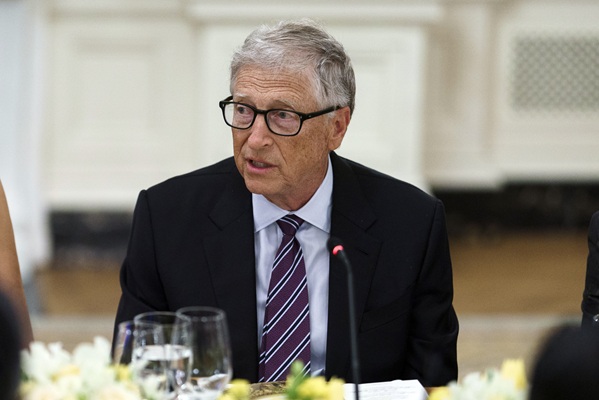
Bill Gates has warned that artificial intelligence is powerful enough to cause events resulting in the deaths of as many as one billion people, intensifying a debate among technology leaders over how governments should regulate the rapidly developing technology.
The Microsoft co-founder said AI could be exploited by terrorists or other malicious actors to develop biological threats or other weapons, making it increasingly difficult to distinguish beneficial applications from dangerous ones.
“AI is certainly powerful enough to drive events that cause a billion deaths,” Gates told NBC.
“So even though it’s pretty hard to get to 100 per cent [of humanity], there’s never been a weapon as powerful as the combination of people with ill intent using the latest AI tools,” he said.
Gates said one of the central challenges for policymakers was distinguishing legitimate research from activity designed to cause mass harm.
“I wish it was easier to distinguish good intent, like ‘I want to design a new drug for a disease’, versus negative intent, which is ‘I want to design a tool of bioterrorism’,” he added.
His comments come amid growing disagreement over the appropriate limits on AI development. Earlier this month, Anthropic said it had detected attempts by Iran-backed Houthi rebels to use its Claude chatbot to assist with the development of advanced ballistic missiles.
Anthropic chief executive Dario Amodei and OpenAI chief executive Sam Altman have both previously argued for greater caution over the pace of AI development.
US President Donald Trump has taken a different approach, resisting regulation of what he has called “super intelligence”, amid concerns that restrictions could leave the US behind China in a strategic technology race.
Gates argued that carefully designed rules would not necessarily undermine American competitiveness.
“You’ll hear from the industry: ‘It’s a very doable thing.’ It would not slow them down dramatically,” he said.
The warning has nevertheless attracted criticism from technology figures who reject predictions of AI-driven catastrophe.
Guillaume Verdon, an AI accelerationist, dismissed extinction concerns in an interview with the New York Post.
“If you ask any of these doomers how it’s supposed to kill us all, they can never flesh out all the details,” he said. “I’m a mathematician. Show me the math.”
Meta chief executive Mark Zuckerberg has likewise rejected more pessimistic narratives about AI, with his company pursuing a campaign highlighting potential benefits from the technology.
Tech policy expert James Czerniawski told GB News that Gates was “just the latest in a big crowd of people trying to go and drum up a lot of hysteria around AI and the risks that it poses to people”.
He argued that unilateral restrictions by western countries could simply allow China, North Korea and other states to continue developing advanced AI without comparable constraints.
The dispute reflects a central tension in AI policy: how to limit potentially catastrophic misuse without slowing technological development that governments and companies increasingly regard as strategically important.




Leave a Comment